Sand, clay and carbon: can a mine’s by-products help poor soils hold more?
PhD work by Sadichhya Adhikari asks whether kaolin mining by-products can stabilise organic carbon in the sandy soils of the Western Australian Wheatbelt.
Poor soils, and an old idea
Much of the Western Australian Wheatbelt sits on deep sandy soils. Sand drains fast and holds little. It struggles to keep clay, organic matter, nutrients and water in the root zone. For carbon, that is a problem. Organic matter added to sand tends to leave again, through leaching, erosion and microbial respiration, rather than staying in the ground.
One old idea is to add clay. Farmers in the region already clay their sandy paddocks to lift productivity and organic matter. Clay gives carbon something to hold onto. Mineral surfaces bind organic molecules and slow their breakdown. In principle, more clay could mean more stable soil carbon, and a step towards lower-emissions farming. In practice, good clay is not always close by, and moving it is expensive.
Waste as a resource
This is where a mine becomes interesting. WA Kaolin Ltd, near East Wickepin in the Wheatbelt, mines kaolin, a soft white clay used in pottery, paper and paint. Only the finest fraction becomes product. The by-products, including the overburden and a coarser clay-rich fraction from ore processing (“Kaosil”), are stockpiled on site and left unused.
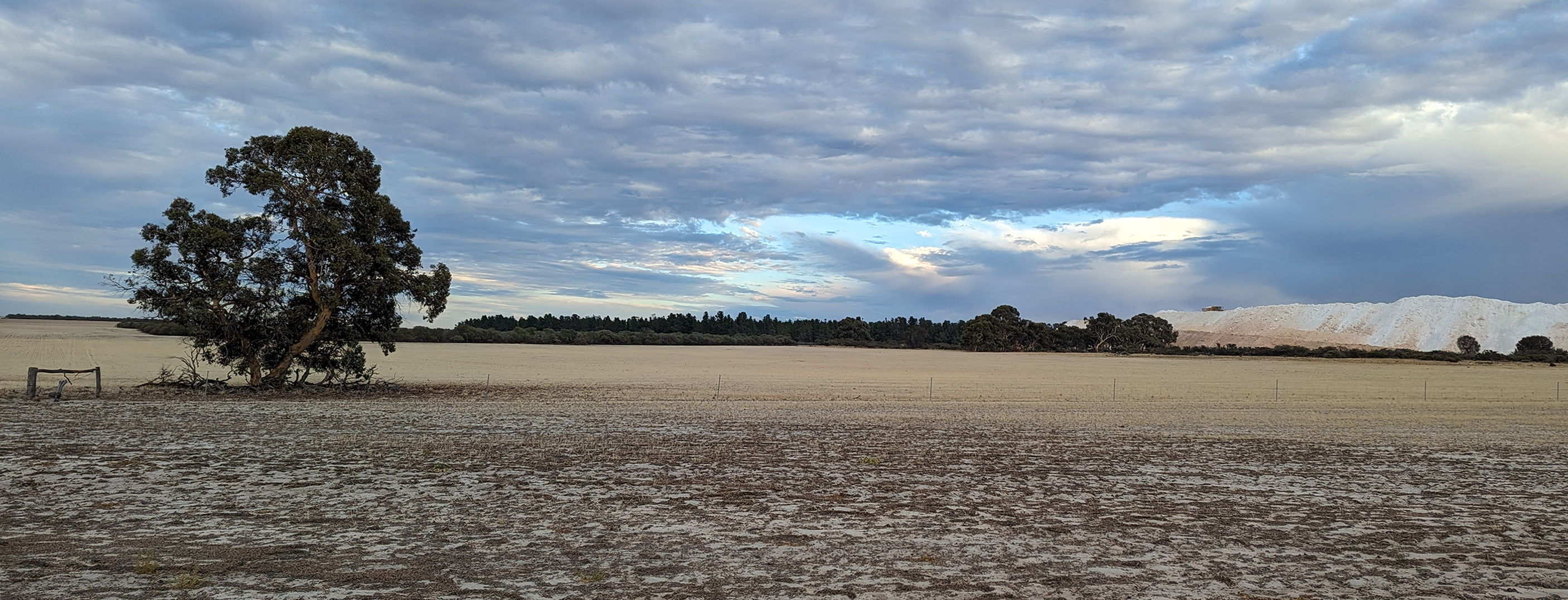
Those by-products contain clay. They sit in a landscape full of sandy soils that need clay. The question that drives Sadichhya’s PhD, in our lab, is simple to state. Can these leftover minerals stabilise organic carbon and improve the condition of nearby sandy soils? If they can, a mine’s waste could help poor soils hold more carbon and farm better.
The work follows the carbon from the mineral surface to the paddock, in four steps. Characterise the by-products. Measure how they bind carbon. Test them in soil with living microbes. Then try them in the field.
What is in the by-products
The first step was to find out what the by-products actually are. Sadichhya used several methods that see the minerals in different ways: infrared spectroscopy and X-ray diffraction for the dominant minerals, mineral mapping via SEM-EDS based techniques for minor phase identification, and X-ray fluorescence for mineral quantification.
The by-products are mixtures, not pure clay. Kaolinite makes up roughly half to two-thirds of them, with the rest mostly quartz sand and a little mica. The by-products have a modest surface area, around 9 to 10 m\(^2\) g\(^{-1}\), and its capacity to hold exchangeable nutrients is low. In Kaosil, the kaolinite is also disordered. This matters. Not all clay is equal, and even small differences in mineralogy can change how much carbon a clay will hold.
How tightly does the clay hold carbon?
The second step tested binding directly. Sadichhya mixed the fine clay fractions of the by-products with two kinds of organic carbon, a humic acid and a dissolved organic carbon, then measured how much the clay took up and how much it let go.
The by-products adsorbed a substantial amount of carbon offered to them, and held on. When the clay was then flushed, at most about a tenth of the bound carbon came back off. How much was taken up depended on the chemistry of the carbon, and, more subtly, on the mineral. The overburden may perform better under more acidic conditions. The message is that these by-products can grab organic carbon and keep it, at least under laboratory conditions.
From laboratory to soil
Laboratory condition is not soil condition. Real soil is alive, and microbes eat carbon. The third step put clay, carbon and soil together and watched the microbes breathe, measuring the carbon dioxide they released over 90 days.
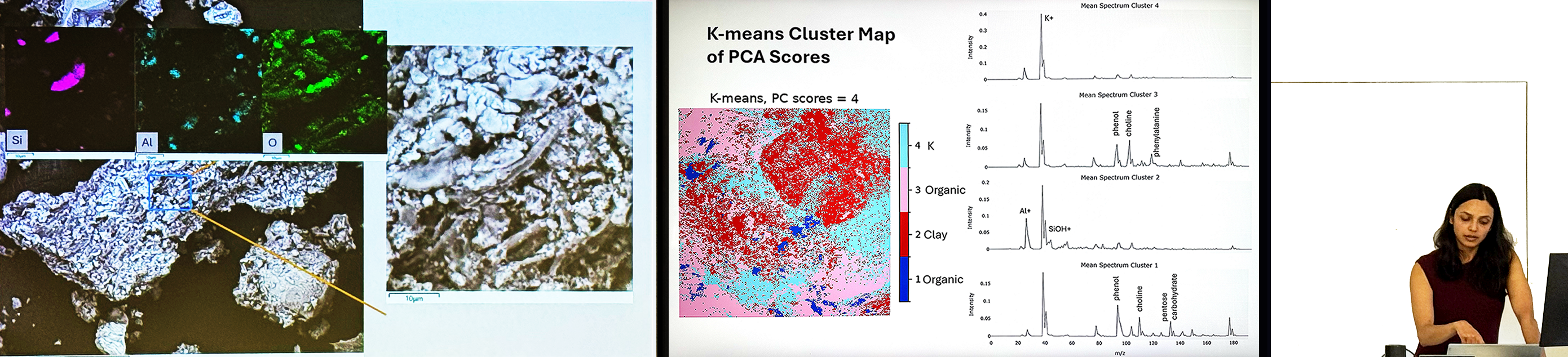
To see the association itself, Sadichhya used surface mass spectrometry to map where carbon sat relative to the clay, down to the micrometre scale. Organic carbon and clay were found together, on the same surfaces. Adding clay also shifted the soil’s texture, its pH and its microbial community. At the small scale, the organo-mineral association that theory predicts is really there, and observable.
The paddock is harder
The fourth step is the field. Since 2024, Sadichhya has applied the Kaosil and overburden by-products to sandy paddocks at two sites, at 100 and 250 t ha\(^{-1}\), and grown pastures and barley over them. She measured moisture, soil respiration, plant biomass and soil carbon amongst other properties.
So far, the field tells a more sober story. There are some trends, but no clear benefit of the clay amendment yet. The micrometre-scale association that shows up in the laboratory has not yet translated into more carbon at the scale of the paddock.
Why this matters
Soil carbon changes slowly. A few seasons is a short time to move a number that reflects decades of inputs and losses. The building blocks are in place. There is enough clay in the by-products, it adsorbs carbon and holds it, and the association forms in soil. Whether that adds up to more stable carbon in the paddock is a question only time and continued measurement can answer.
The value of the work is that it tests every step, from the mineral surface to the field, rather than stopping at the promising laboratory result. It also joins two problems that are usually kept apart: a mine with clay-rich waste it cannot sell, and farmland with sandy soil that cannot hold carbon. If the field eventually follows the laboratory, even a little, the leftovers of one industry could help another store carbon and farm better. That is worth the patience.
Acknowledgements
We thank WA Kaolin Ltd for funding Sadichhya Adhikari’s PhD research and for providing the by-products. We also thank Callan Sims for access to the field sites and for spreading and incorporating the by-products in the soil.