An underground census: what bacteria and fungi tell us about ecosystem health
A new bacterial:fungal richness ratio offers a practical way to read the biological character of soils across Australia
Most of what keeps an ecosystem working happens out of sight. Beneath every grassland, forest, farm and desert shrubland is a living community of bacteria, fungi and other organisms that decompose organic matter, cycle nutrients, support plants and help regulate carbon and water. Soil health is therefore not only a question of chemistry or texture. It is also a question of life.
The difficulty is that soil life is extraordinarily complex. DNA-based microbiome methods now let us identify thousands of microbial taxa in a soil sample, but that creates a practical challenge: how can this complexity be turned into information that helps us monitor, compare and manage ecosystems at broad scales?
That is the motivation behind our new paper in Communications Earth & Environment, “Decoding bacterial and fungal richness with autoencoders yields a unified ratio indicating soil health and ecological susceptibility”. We examined bacterial and fungal richness across Australian soils and asked whether their balance could provide an interpretable indicator of microbial community structure and ecological condition.
The idea is simple, but useful. Bacterial richness tells us how many bacterial taxa are present. Fungal richness tells us the same for fungi. Their ratio, the bacterial-to-fungal richness ratio, does not measure everything about the soil microbiome. It does not replace measurements of biomass, abundance, function or specific microbial groups. But it does provide a broad signal of whether a soil microbial community is relatively more bacterial-rich or fungal-rich, and how that balance changes across climate, vegetation, soil and land-use gradients.
At a continental scale, Australia’s soils are clearly not microbiologically uniform. Bacterial and fungal richness have different spatial patterns, and those patterns are not simply biological copies of familiar maps of rainfall, soil carbon, soil type or pH. Climate sets broad limits, but the final microbial patterns are shaped by many interacting factors: vegetation, terrain, mineralogy, nutrient status, organic carbon, water availability, pH and land use.
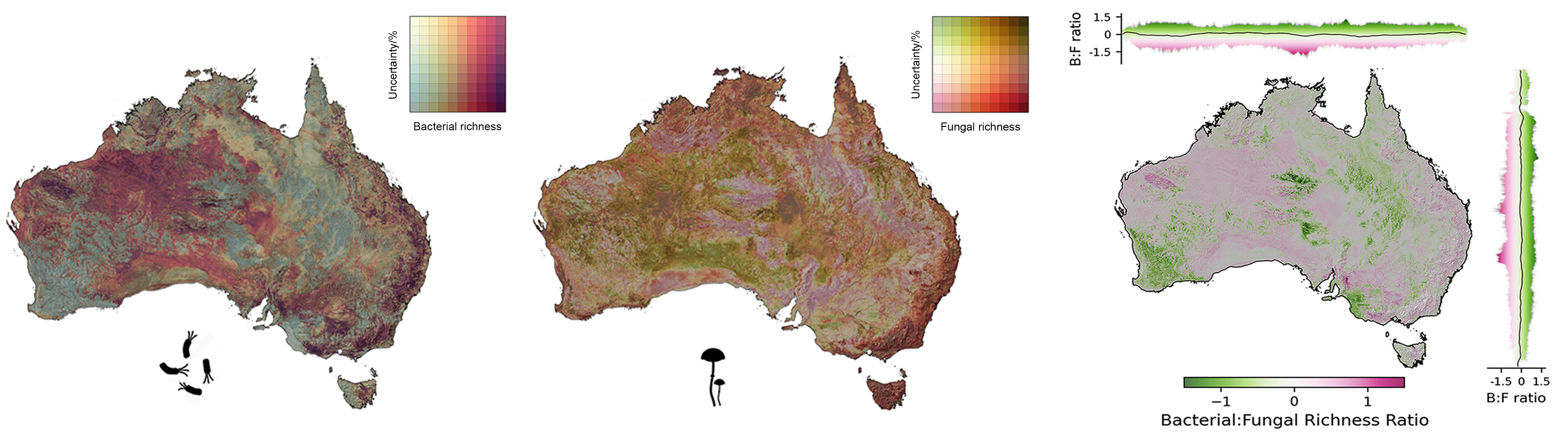
That distinction matters. If microbial richness simply followed rainfall or soil carbon, then existing environmental maps would already tell most of the story. They do not. The bacterial and fungal richness maps show a distinct biological geography, one that integrates many environmental controls into a picture of how soil communities are organised across Australia.
The contrast between bacteria and fungi is especially important. In our analysis, bacterial richness was associated with a broad mix of terrain, soil texture, nutrient status and landscape complexity. Bacteria appear to persist across a wider range of conditions and respond to several forms of environmental heterogeneity. Fungal richness, by contrast, was more tightly linked to moisture, vegetation, organic carbon and habitat stability. Fungi tended to be richer in wetter, more vegetated and organic-rich environments, and poorer in more arid or intensively disturbed settings.
This asymmetry gives the bacterial-to-fungal richness ratio its value. A high ratio points to relatively greater bacterial richness; a low ratio points to relatively greater fungal richness. Across Australia, high ratios are more common in arid and semi-arid environments, while lower ratios occur in cooler, wetter, more organic-rich and often more vegetated systems. The ratio therefore acts like a biological summary of ecological conditions, especially where water availability, organic inputs, nutrient balance and disturbance shape the soil community.
It is useful to think of the ratio not as a diagnosis, but as a warning signal or ecological context indicator. By itself, it does not say whether a soil is healthy or unhealthy. But it can help identify where microbial communities have shifted towards one kind of structure or another, where ecosystems may be more susceptible to drying, nutrient imbalance or land-use pressure, and where more detailed biological or functional measurements may be needed.
To move from these maps to the factors that help explain them, the modelling approach was also important. We combined DNA-based microbial data, mid-infrared soil spectroscopy, supervised deep autoencoders, explainable AI and structural equation modelling. In plain language, this allowed us to do three things: estimate microbial richness across many more soil samples, detect nonlinear environmental patterns that simpler models may miss, and then interpret which environmental controls mattered most.
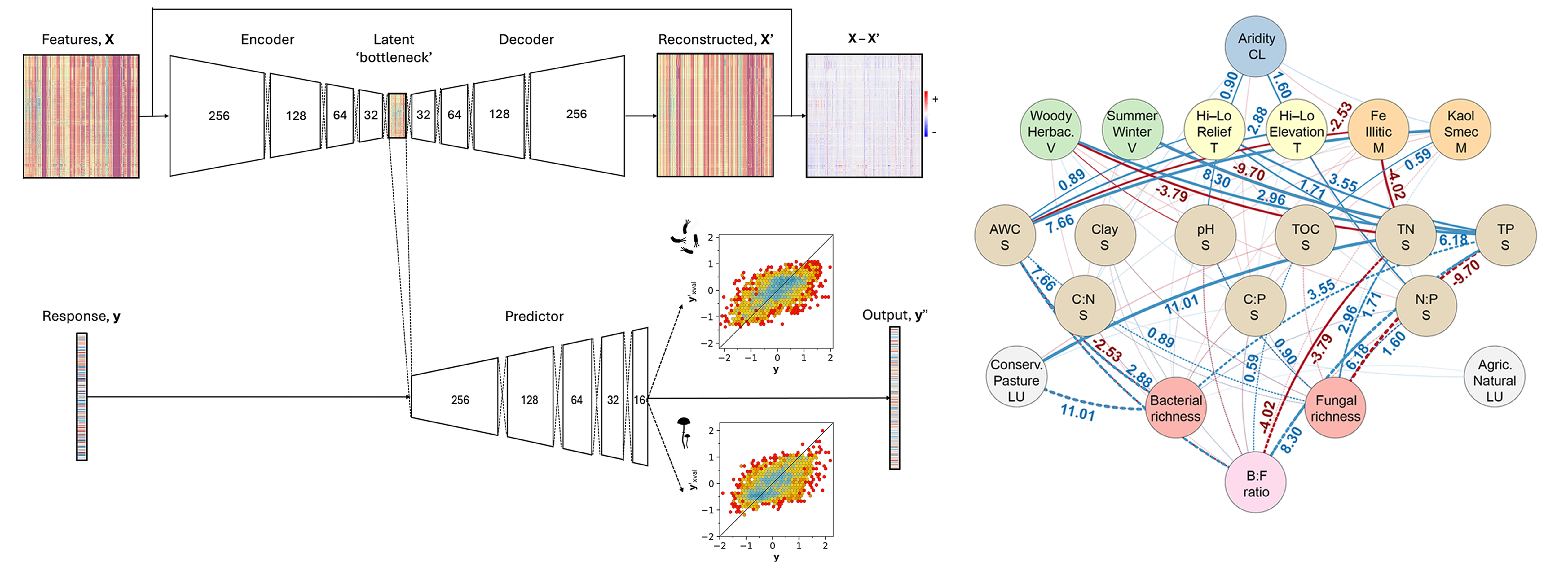
The autoencoder was not used for prediction alone. It helped compress many environmental variables into simpler gradients, while explainable AI and structural equation modelling helped unpack how those gradients related to bacterial richness, fungal richness and their ratio. This matters because ecological systems rarely respond to one factor at a time. Moisture, carbon, nutrients, pH, terrain and vegetation interact, and those interactions can differ for bacteria and fungi.
The paper also makes an important distinction. The bacterial-to-fungal richness ratio is not the same as the more familiar bacterial-to-fungal biomass ratio used in soil ecology. Biomass ratios describe the relative amount of bacterial and fungal material. Richness ratios describe the relative diversity of bacterial and fungal taxa. Both are useful, but they answer different questions. Biomass says more about quantity; richness says more about the variety of organisms present and the range of ecological strategies that may be available.
That difference is why the richness ratio should be seen as complementary, not competing. A robust assessment of soil health will always need multiple lines of evidence: physical condition, chemistry, carbon, nutrients, water, vegetation, microbial biomass, microbial diversity and, where possible, direct measures of function. The value of the richness ratio is that it brings soil biodiversity into that toolkit in a way that is spatially explicit, scalable and relatively easy to communicate.
There is still more to test. Richness is not function. A soil can contain many taxa without necessarily performing all ecological processes well, and a single ratio cannot capture the full complexity of a microbial community. The ratio should therefore be interpreted carefully, alongside other soil and ecosystem information.
The bacterial-to-fungal richness ratio is promising because it does not claim to do everything. It offers one interpretable lens on a hidden part of ecosystems that is usually difficult to observe at scale. It helps translate soil biodiversity from an overwhelming list of DNA sequences into a map, a gradient and a conversation about ecological condition.
For land managers, ecologists and policy makers, that matters. If we want to care for soils as living systems, we need ways to observe their biology, not only their chemistry. This work is a step towards that goal: a practical way to bring the underground life of soils into how we monitor, interpret and protect ecosystems.