The missing number: how much more carbon can soils hold?
…and how quickly can we measure it? Prompted by a new paper by Hu and Viscarra Rossel (2026) in SOIL.
Soils are not empty carbon buckets
Soil carbon is often treated as if every soil is an empty bucket waiting to be filled. Add more plant residues, reduce disturbance, improve management, and the soil should keep storing more carbon. But soils have limits. Some still have room to stabilise more organic carbon, while others are already close to their mineral capacity. The real question is not only how much carbon is in the soil, but how much more it can realistically hold in the environment in which it occurs, and whether we can measure that quickly enough to guide decisions.
This is an important shift in how we think about soil carbon. We often talk about soil organic carbon as a stock, or a total amount stored in the ground. That is useful, but it does not tell the whole story. Two soils can contain the same amount of carbon, but one may still have a lot of capacity to store more, while the other may already be close to its limit.
The reason is that not all soil carbon is stored in the same way. Some organic matter is fresh and loose, such as plant fragments and residues, and it is easily decomposed. Some is more strongly protected because it becomes attached to fine mineral particles, such as clay and silt, where it can stay in the soil for longer. Another form is pyrogenic organic carbon that comes mainly from fires; it stays in the soil for a very long time, but we will not discuss it further here. For the mineral-associated organic carbon, the mineral surfaces that help protect this carbon are not unlimited. At some point, they begin to fill up.
Estimating the deficit
This is where the idea of carbon saturation becomes useful. Instead of only asking, “how much carbon is in this soil?”, we can also ask, “how much more carbon could this soil realistically stabilise?” The difference between the amount of carbon a soil currently holds and the amount it could potentially hold is called the carbon saturation deficit. Put simply, it is the remaining room for more stable soil carbon.
Our earlier paper in Global Change Biology developed a robust way to estimate this for Australian soils. The method focused on mineral-associated organic carbon and the amount of fine soil material. Rather than using an average linear relationship between the mineral-associated organic carbon and the amount of fine soil material, like current models, it looked at the upper boundary of that relationship, the soils that were holding the most carbon for their amount of clay and silt. That upper boundary gives an estimate of what similar soils might be able to store under their current environments of climate, land use and management.
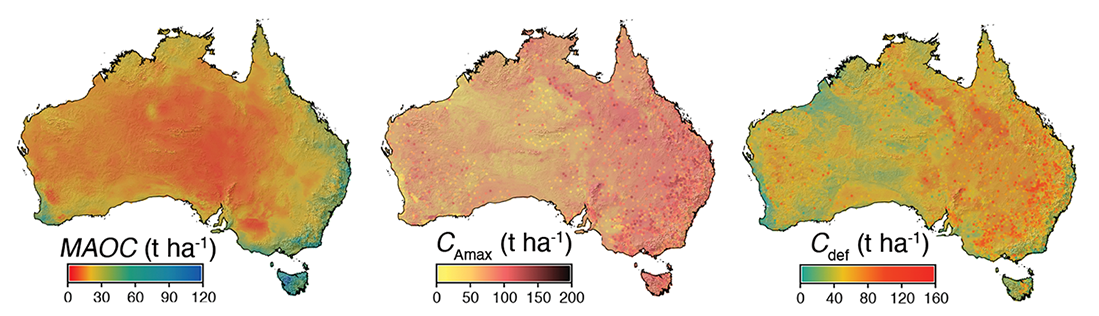
The study showed that Australian soils still have a large carbon saturation deficit. That does not mean all of this carbon will be stored. Soil carbon depends on climate, rainfall, vegetation, nutrients, land use and management. But the work helped make the question more realistic. It showed that the potential to store more carbon is not the same everywhere.
This matters for farmers, land managers, carbon projects and students trying to understand climate solutions. Some soils may have a large opportunity to store more stable carbon if management improves. Other soils may already be closer to their mineral capacity, or under unfavourable environmental conditions, so expectations need to be more cautious. Carbon saturation does not make soil carbon less important. It helps us avoid treating every soil as if it behaves the same way.
Measuring it faster
The challenge is that measuring carbon saturation deficit is not simple. Traditional laboratory methods can be slow and expensive, especially if we want to measure many soils across large areas. That is where the new paper by Hu and Viscarra Rossel (2026) in SOIL comes in.
The new study asks whether we can estimate this missing number more quickly using mid-infrared spectroscopy. This technique works by shining infrared light on a soil sample and measuring how the soil absorbs that light. The result is a spectrum, which acts a bit like a fingerprint. It contains information about organic matter, minerals and texture.
By combining these spectra with machine learning, the study showed that it is possible to estimate mineral-associated organic carbon and the carbon saturation deficit rapidly. Importantly, the work also used explainable machine learning, which helps show which parts of the spectrum were important for the prediction. That matters because we do not just want a model that gives an answer. We want to know whether the answer makes scientific sense.
The important message is that soil carbon science is moving from simply measuring what is there to estimating what is possible. A carbon stock tells us where the soil is now. A carbon saturation deficit helps tell us how much room may still be left.
For soil carbon management, that missing number could be very useful. It could help identify where efforts to increase soil carbon are more likely to succeed. It could help avoid unrealistic claims in places where soils are already close to their capacity. And it could make monitoring faster and more affordable.
Soils are not empty carbon buckets. They are complex living and mineral systems, each with its own history, constraints and potential. Understanding those limits does not make soil carbon less exciting. It makes the science more honest, and the decisions more useful.
References
Hu, Y. & Viscarra Rossel, R.A. (2026). Estimating soil carbon sequestration potential with mid-IR spectroscopy and explainable machine learning. SOIL, 12, 619–631. https://doi.org/10.5194/soil-12-619-2026
Viscarra Rossel, R.A., Webster, R., Zhang, M., Shen, Z., Dixon, K., Wang, Y.-P. & Walden, L. (2024). How much organic carbon could the soil store? The carbon sequestration potential of Australian soil. Global Change Biology, 30, e17053. https://doi.org/10.1111/gcb.17053