Why soil sensing needs more than spectroscopy
On the occasion of a new paper by Hu et al. (2026) in the European Journal of Soil Science
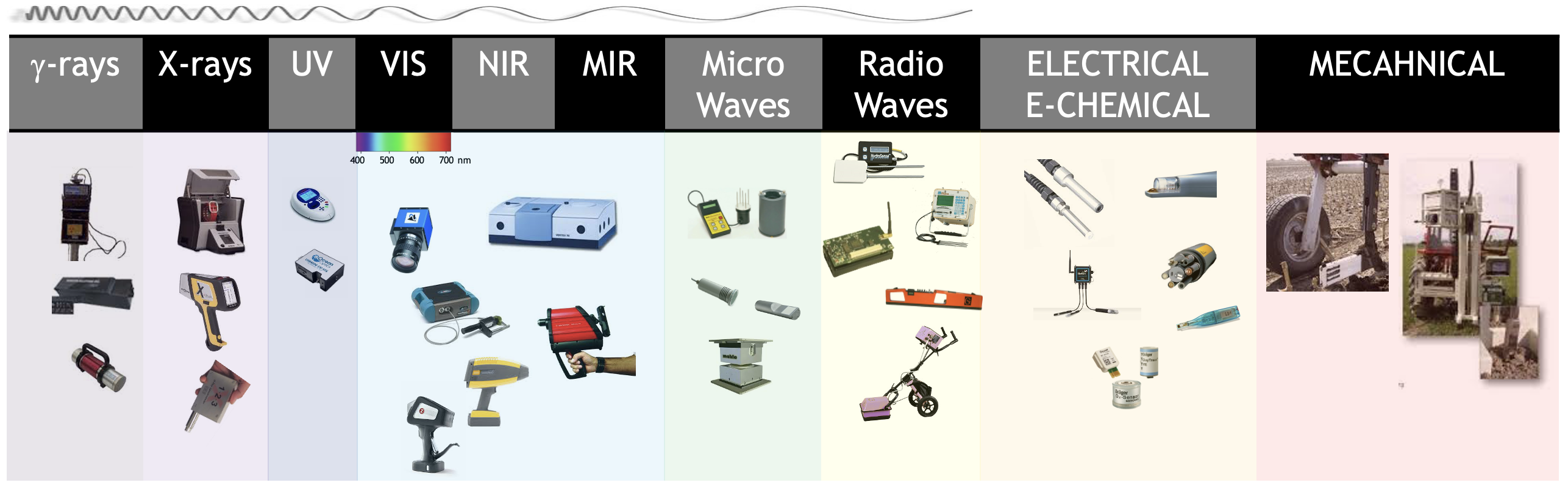
For the past twenty years or so, soil sensing has been almost synonymous with soil spectroscopy. Visible, near-infrared and mid-infrared diffuse reflectance spectroscopy have rightly earned their place: they are fast, non-destructive, require minimal sample preparation, and can estimate dozens of soil properties from measurement of a single spectrum. Thousands of papers, multiple global and continental spectral libraries, and a growing number of commercial instruments testify to the success of the approach. If you attend a soil science conference and wander into a sensing session, you could be forgiven for thinking spectroscopy is the only game in town.
But it is not, and it should not be. Spectroscopy works by measuring how soil absorbs and reflects light across a range of wavelengths. It is powerful for properties that leave strong spectral signatures, such as organic carbon, clay mineralogy, moisture, but it is fundamentally an indirect method. It infers composition from molecular vibrations and electronic transitions, not from the elements themselves. When you need to know what elements are actually present in a soil, and at what concentrations, spectroscopy struggles. It cannot easily distinguish total elemental concentrations from the molecular context they sit in, and for elements at low abundances or without distinctive absorption features, it can be effectively blind. That is a significant gap if your interest is in nutrient availability, contamination, or the elemental stoichiometry that increasingly links soil chemistry to soil biology.
The soil sensing community has, understandably, ridden the spectroscopy wave hard. But a wave is not the ocean. There are other technologies that have also been maturing, and an interesting one is Laser-Induced Breakdown Spectroscopy, or LIBS.
Firing lasers at soil: a short history
The principle behind LIBS is simple. Fire a high-energy laser pulse at a material, ablate a tiny amount of its surface, and create a transient plasma–a micro-explosion, essentially, that briefly reaches temperatures hotter than the surface of the sun. As that plasma cools over a few microseconds, the excited atoms radiate light at wavelengths characteristic of each element present. Capture that light with a spectrometer and you have a simultaneous multi-element fingerprint of whatever you just vaporised.
The phenomenon was first observed in the 1960s, almost as soon as lasers existed. For decades it remained a bench-top technique, confined to physics and analytical chemistry laboratories where it found a natural home in metallurgy and industrial quality control. Useful, but bulky, expensive, and nowhere near portable for field use. Through the 1970s and 80s the instrumentation improved incrementally, and by the early 1990s LIBS had accumulated a respectable literature on metals, alloys, geological samples and industrial materials. Soils, however, were barely on the radar.
That changed in the mid-1990s, driven by the need to screen contaminated sites for toxic heavy metals. In 1996, Eppler and colleagues at Los Alamos National Laboratory published a rigorous benchtop study of matrix effects on lead and barium detection in soils, while Ciucci’s group in Italy independently demonstrated time-resolved LIBS for trace pollutants in soil. That same year, Los Alamos described the first transportable LIBS system for field-based soil analysis, and Theriault and Lieberman field-deployed a LIBS probe for rapid delineation of metal contamination. Benchtop and field-portable development ran in parallel from the start.
In 2001, Cremers and colleagues extended LIBS to soil carbon, reporting a strong correlation between emission-line ratios and total carbon determined by dry combustion. That opened the door to broader soil science applications, and through the following decade the work expanded to macro- and micronutrients, heavy metals, pH, and soil texture via elemental proxies, accelerated by the miniaturisation of solid-state lasers and spectrometers, and a growing demand for rapid, multi-element characterisation that conventional lab methods like ICP-OES, ICP-MS, and wet chemistry, could not deliver at scale. Truly handheld instruments arrived around 2013–2014, SciAps introduced the first commercial handheld LIBS analyser with enough laser energy to produce adequate spectra from soil. A technique that once required an optical bench could now be carried to the field in a case the size of a power drill.
That portability matters enormously. Conventional elemental analysis means collecting a sample, shipping it to a laboratory, dissolving it in acid, and running it through an ICP instrument, days to weeks, tens to hundreds of dollars per sample per element. Handheld LIBS promises seconds, on site, for all elements simultaneously. The catch is that “in principle” and “in practice” are separated by a thicket of analytical challenges: matrix effects, sample heterogeneity, sample preparation, instrument precision, and the sheer complexity of soil as a material.
Getting the fundamentals right
This brings us to our recent paper in the European Journal of Soil Science (Hu et al. 2026), which deals with one of the less glamorous but entirely essential questions: what does it actually take to get reliable measurements from a handheld LIBS instrument when the target is soil?
The short answer is: more than you might think. The work systematically investigates how grinding time, binder addition, and soil texture affect pellet quality, spectral signal, and measurement precision. Sandy soils, it turns out, are particularly problematic–they produce weak, crumbly pellets with poor cohesion, leading to noisy, variable signals. Grinding longer helps. Adding a binder like potassium bromide helps more, especially for sandier samples. But the effects are element-dependent: what improves the signal-concentration relationship for carbon and iron can have little effect on silicon, and can even complicate matters for aluminium. There is no single recipe that optimises everything.
The paper also quantifies something that handheld LIBS studies have largely sidestepped: between-day reproducibility. Most studies report within-session repeatability, which is the easy part. The harder question is whether you get the same answer on Monday as you do on Wednesday, and the answer, consistent with bench-top LIBS literature, is “not quite”. Day-to-day variability is real, influenced by both instrument drift and subtle changes in sample condition, and it means that careful experimental design–measuring everything on the same day where possible–is not a luxury but a necessity.
These are the kinds of foundational details that determine whether a promising technology matures into a trusted analytical tool or remains a laboratory curiosity with impressive but irreproducible results. They are not the most exciting findings, but they are among the most important.
Why we need more than one lens
The instinct to compare sensing technologies as rivals—LIBS versus spectroscopy versus pXRF—misses the point. Each method interrogates soil in a fundamentally different way, and those differences are features, not bugs.
vis–NIR and mid-infrared spectroscopy read the molecular composition of soil: the bonds in organic functional groups, those of water molecules bound to clay surfaces, the crystalline lattice vibrations of minerals. They are superb at estimating organic matter, clay content, cation exchange capacity and moisture, for example. But they cannot tell you the total concentration of aluminium or iron or silicon in any direct sense. They see the bonds between molecules, not atoms.
LIBS, by contrast, sees atoms. It ablates the sample and reads the elemental emission lines directly. It can detect light elements–carbon, nitrogen, even hydrogen–that are invisible to portable X-ray fluorescence. It provides spatially resolved elemental maps at sub-millimetre scales, which is valuable for understanding how elements are distributed within a sample or across a soil surface. But it is micro-destructive, sensitive to how the sample is presented, and affected by matrix effects that can make the relationship between signal intensity and actual elemental concentration surprisingly non-linear.
Portable XRF fills yet another niche: it handles heavier elements from around magnesium upward with some sample preparation and no sample destruction, but it is blind to the very elements–carbon, nitrogen, phosphorus–that matter most for understanding soil organic matter, fertility and biological function.
The point is not that one of these is better than the others. A soil sample measured with vis–NIR spectroscopy, mid-infrared spectroscopy, then analysed with handheld LIBS, and perhaps also measured with pXRF, would yield a chemical portrait far richer than any single technique could provide. The organic matter and mineralogy from spectroscopy, the light-element concentrations from LIBS, and the heavy trace elements from pXRF. Together, these start to approach a comprehensive characterisation, rapidly and more affordably than conventional methods. Sensor fusion is where the real analytical power lies, but it requires the community to invest in multiple sensing platforms rather than defaulting to the one it already knows best.
The next decade
The soil sensing field has been spectroscopy-centric for good reason, but the next decade needs to be more pluralistic. We need sensing approaches that can characterise soils from multiple angles–molecular, elemental, physical–and we need the data fusion and machine learning methods to integrate these complementary views into coherent, actionable information. LIBS is one important piece of that puzzle. Geophysical methods–electromagnetic induction, ground-penetrating radar, gamma-ray spectrometry, electrochemical sensing–are another. Hyperspectral imaging and technologies we have not yet imagined will add further dimensions.
The goal is not to crown a single champion technology but to assemble a diverse, interoperable sensing ecosystem that matches the complexity of the material it is trying to characterise. Soil is arguably the most complex material on the surface of the Earth: spatially variable, temporally dynamic, chemically heterogeneous, biologically alive. It seems only fitting that understanding it should demand more than one way of looking.
References
Ciucci, A., Palleschi, V., Rastelli, S. et al. (1996). Trace pollutants analysis in soil by a time-resolved laser-induced breakdown spectroscopy technique. Applied Physics B, 63, 185–190. doi.org/10.1007/BF01095271
Cremers, D.A., Ebinger, M.H., Breshears, D.D., Unkefer, P.J., Kammerdiener, S.A., Ferris, M.J., Catlett, K.M. & Brown, J.R. (2001). Measuring total soil carbon with laser-induced breakdown spectroscopy (LIBS). Journal of Environmental Quality, 30, 2202–2206. doi.org/10.2134/jeq2001.2202
Cremers, D.A., Ferris, M.J. & Davies, M. (1996). Transportable laser-induced breakdown spectroscopy (LIBS) instrument for field-based soil analysis. Proceedings of SPIE, 2835, 190–200. doi.org/10.1117/12.259772
Eppler, A.S., Cremers, D.A., Hickmott, D.D., Ferris, M.J. & Koskelo, A.C. (1996). Matrix effects in the detection of Pb and Ba in soils using laser-induced breakdown spectroscopy. Applied Spectroscopy, 50, 1175–1181. doi.org/10.1366/00037029639051
Hu, Y., Cross, A., Shen, Z. & Viscarra Rossel, R.A. (2026). Soil sensing with a handheld LIBS: Effect of sample preparation and instrument precision. European Journal of Soil Science, 77(2), e70305. doi:10.1111/ejss.70305.
Theriault, G.A. & Lieberman, S.H. (1996). Field deployment of a LIBS probe for rapid delineation of metals in soils. Proceedings of SPIE, 2835. doi.org/10.1117/12.259760